
Professional Sign Installation Practices That Support Long-Term Performance
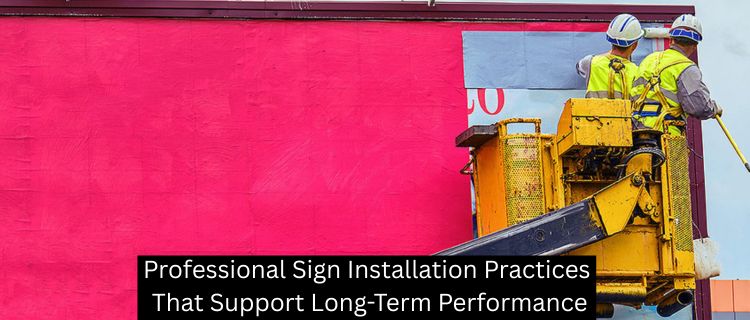
A sign can be perfectly designed and flawlessly fabricated and still fail to perform as intended if the installation is done poorly. Installation is the phase of a sign project that most business owners see only briefly — a crew arrives, works for a few hours or a day, and the sign is up. What happens during those hours determines how the sign performs over the next ten years. The methods used to mount, level, anchor, wire, and seal a sign have direct consequences for its appearance, its longevity, and in some cases, its safety. Professional installation is not a formality at the end of a sign project — it is the step that makes everything else worthwhile.
Why Does Installation Quality Affect Long-Term Sign Performance?
Signs in outdoor environments face ongoing physical stress. Wind loads push and pull at sign faces and mounting hardware. Thermal expansion and contraction cycles put stress on fasteners and structural connections. Moisture seeks any unsealed penetration. UV exposure degrades materials that are not properly protected. A professional installation anticipates all of these forces and accounts for them in how the sign is mounted, sealed, and supported.
An installation that ignores these factors may look fine at the time of completion. The problems appear later — a sign that shifts slightly out of level as thermal cycling loosens fasteners, moisture infiltration into an illuminated sign cabinet that was never properly sealed, or a sign face that vibrates in the wind because the mounting was not tight enough. These issues are almost entirely preventable with correct installation practices.
What Does Professional Sign Installation Involve?
Site Assessment And Preparation
Before any hardware goes into a wall or post, the installation site needs to be assessed. For wall-mounted signs, that means identifying the wall structure — stud locations, masonry type, any penetrations already present — and selecting fasteners and mounting hardware appropriate for that substrate. For freestanding monument and pole signs, it means verifying that the concrete foundation meets the engineering specifications for the sign’s wind load requirements.
Structural Mounting And Anchoring
The method used to attach a sign to its mounting surface must be appropriate for both the sign’s weight and the forces it will experience in service. Wall anchors must engage the right substrate with the right holding strength. Post and pole connections must be sized and positioned correctly. Monument sign foundations must be poured to the correct depth and diameter. These are not decisions to be made on the fly — they should be specified during the project planning phase and executed precisely in the field.
Electrical Connections For Illuminated Signs
Illuminated signs require electrical connections that are made safely, in accordance with applicable codes, and in a way that protects the components from moisture infiltration. Our installation crews include electricians qualified to perform sign electrical work, and all electrical connections are made to code requirements. Signs are tested for full function before the installation crew leaves the site.
Leveling, Alignment, And Finishing
A sign that is even slightly off-level or misaligned draws the eye in exactly the wrong way. Precision in this step requires the right tools, patience, and a trained eye. After mounting, any penetrations through the building envelope are sealed to prevent moisture entry. Visible fasteners are covered with matching caps. The installation area is cleaned and left in better condition than it was found.
What Installation Mistakes Cause The Most Problems For Sign Owners?
- Using fasteners or anchors not rated for the wall substrate, leading to movement or failure over time
- Leaving unsealed penetrations that allow water to enter the building or the sign cabinet
- Inadequate foundation depth for monument or pole signs in wind-exposed locations
- Electrical connections made without proper weatherproofing, causing component failure in outdoor signs
- Poor leveling at installation that compounds into a visible tilt as the sign settles
- Incorrect positioning relative to the permitted specifications, requiring reinstallation
Why Does Nevada’s Climate Create Specific Installation Demands?
Las Vegas presents installation conditions that differ from more temperate climates. Summer temperatures during installation can affect adhesive-applied sign components if not managed correctly. Wind exposure at many commercial locations in the Las Vegas valley is significant, and signs must be anchored to withstand sustained winds as well as gusts. The desert environment also means that any penetration left unsealed, while it may not face rain immediately, is exposed to dust, temperature cycling, and the occasional monsoon rain event.
Our installation crews are trained for these conditions. We apply the practices appropriate to Nevada’s climate, not generic installation methods developed for different environments. That local expertise is part of what makes the difference between a sign that holds up and one that begins to show problems within a few years.
Why Do Las Vegas Businesses Choose Las Vegas Custom Signs For Installation?
- Experienced installation crews with expertise across every sign type we fabricate
- Qualified electricians for all illuminated sign electrical connections
- Site assessment and hardware specification before installation begins
- Precision leveling and alignment practices on every installation
- Full weatherproofing of all penetrations and connections
- Post-installation testing of all illuminated components before project sign-off
- Compliance with all applicable codes and permit requirements
Frequently Asked Questions
Do You Handle Electrical Connections For Illuminated Signs?
Yes. Our installation crews include qualified electricians for sign electrical work, and all connections are made to code requirements. We test all illuminated components fully before completing the installation.
What Happens If A Sign Needs To Be Repositioned After Installation?
We confirm positioning against the approved plans and permit specifications before making any permanent connections, which minimizes the need for repositioning. If an adjustment is required, we address it before leaving the site.
Do You Offer Maintenance Or Service After Installation?
Yes. We provide ongoing maintenance and service support for the signs we install, including lamp and LED replacements, face replacements, and structural repairs as needed.
The quality of your sign installation determines how well your investment performs over its service life. Contact Las Vegas Custom Signs to discuss your installation needs and learn how our professional installation practices protect the value of every sign we build.
Back